
How Refrigerated Containers Work at the Port
How to Choose a Container Drayage Company
CE Dispatch
How a Refrigerated Container Actually Works: A Port Shipper’s Guide to Reefer Drayage
The single most expensive misunderstanding in temperature-controlled freight is this: a refrigerated container does not chill your cargo. It holds the temperature your cargo already has. A reefer unit circulates cold air to maintain the pulp temperature of the load as it was at the moment of stuffing. If product goes into the box warm, the machinery may pull it down over many hours, but that is not what it was built to do, and the claim that follows will reflect it.
Understanding that distinction, and the handful of operational details that follow from it, is what separates shippers whose reefer loads arrive clean, from shippers who spend their quarter arguing over temperature logs. For importers and exporters moving perishables, seafood, pharmaceuticals, or any temperature-regulated cargo through Norfolk International Terminal and Virginia International Gateway, here is how the equipment actually functions and where cold chains actually break.
What a Refrigerated Container Does, and What It Does Not Do
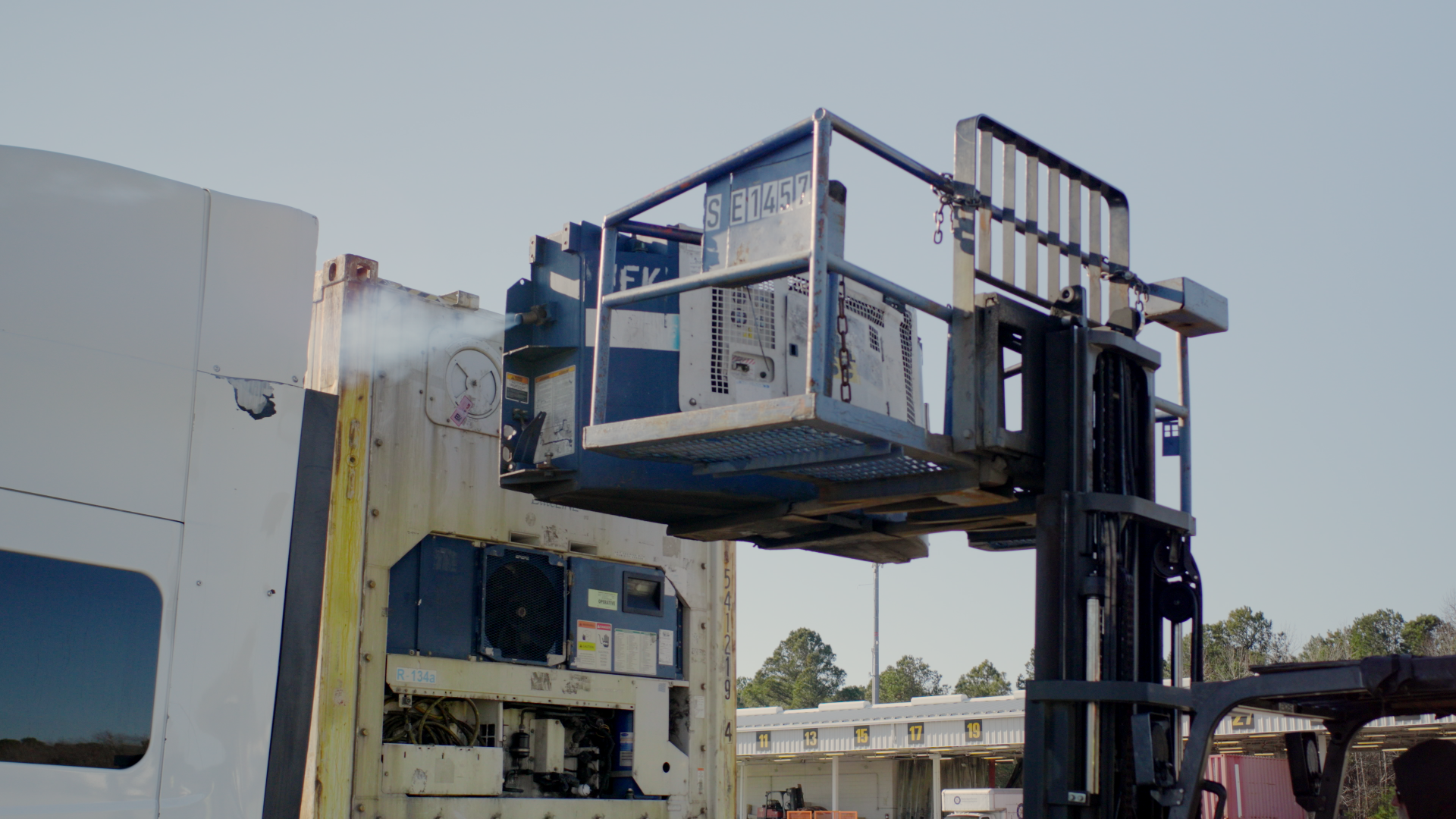
A reefer is an insulated steel container with an integrated refrigeration unit built into one end. It draws air from the cargo space, passes it across an evaporator coil, and discharges chilled air back into the container through T-shaped floor decking. That air travels the length of the load underneath the cargo, rises through and around it, and returns to the unit to be cooled again. The cycle is continuous as long as the unit has power.
Marine loss prevention guidance is unambiguous on the limitation. A reefer container is designed to maintain the pulp temperature of the cargo as at the time of stuffing. Reducing the temperature of warm cargo is not its primary function. Cargo must be pre-cooled to its carriage temperature at the packhouse before loading. A container that receives warm product will show a return air temperature the machinery cannot bring down quickly, and the far end of the load will stay warmest the longest.
Stowage matters for the same reason. Cargo sits on the decking so air can pass underneath it. A load stacked into the return air path starves the far end of the container of circulation, which produces exactly the uneven temperature readings that generate claims.
The Power Handovers Where Reefer Cold Chains Break
Reefer shipping rarely fails inside the container. It fails in the gaps between power sources. A refrigerated container changes its power supply at nearly every stage of its journey, and failures cluster at those transitions rather than distributing randomly across the move.
|
Stage |
Power Source |
Where It Fails |
What Protects the Load |
|
On the vessel |
Ship’s power |
Rare, since vessel reefer bays are monitored continuously throughout the voyage |
Carrier monitoring and downloadable voyage temperature records |
|
Terminal dwell at NIT or VIG |
Terminal plug-in racks |
Waiting for an available plug point during peak import volume, or a plug that was never properly seated |
Confirming plug-in status at discharge and keeping terminal dwell short |
|
Chassis cycling and genset attachment |
Transition period with no power |
The highest risk window in the entire move. The container is unplugged while it is mounted and the genset is attached and started |
A fueled, pre-tripped genset staged in advance and a driver who verifies the unit restarts |
|
Road leg |
Clip-on diesel genset |
Genset runs out of fuel or fails mechanically. It is an independent engine, so tractor condition is irrelevant to it |
Fuel level verified at pre-trip against total route time, not estimated |
|
Delivery and unload |
Receiver’s dock power, or none |
Container sits unplugged in a yard waiting for a door, often for hours |
A named maximum unplugged time agreed with the receiver before dispatch |
The chassis cycling and genset attachment window deserves particular attention because it is both the highest risk point and the one most often treated as routine. The container comes off terminal power, gets mounted, and runs on nothing until the genset is attached and confirmed running. That gap compresses hardest during peak import surges, when terminal dwell times shrink and reefer plug availability tightens at the same moment volume is highest.
Pre-Trip Inspection: What PTI Covers and Why It Is Not Pre-Cooling
A pre-trip inspection, or PTI, is performed on an empty refrigerated container before it is released for a booking. It verifies that the cooling unit, temperature controller, and recording devices all function correctly. A full PTI inspects compressor mountings, bolts, electrical connectors, hoses, cable condition, and insulation integrity, and typically runs the unit down to a frozen setpoint for a sustained period to confirm it can hold temperature under load.
Two points are commonly confused and worth stating plainly. First, PTI is not pre-cooling. PTI tests the machine. Pre-cooling brings the product down to carriage temperature before it is packed, and that happens at the packhouse, not at the terminal. Second, a PTI goes stale. Industry guidance calls for the inspection to be repeated if the unit has not been used for a booking within roughly a month.
On the roadside, the reefer pre-trip is a shorter but equally consequential check: genset fuel level measured against total route time, setpoint confirmed against the booking, alarm and fault codes read off the control panel, and seal integrity verified. It is roughly a fifteen-minute procedure. It becomes a two-minute procedure when a driver is racing a terminal appointment window, and a marginal unit that passes a rushed inspection but drifts in transit is one of the hardest excursion causes to prove after the fact.
Reading Supply Air and Return Air Temperature
Every reefer records two temperatures, and knowing which one you are looking at prevents a great deal of unnecessary alarm.
Supply air, sometimes called delivery air, is the chilled air leaving the unit and entering the cargo space. Return air is the air coming back to the unit after traveling through the load. For frozen cargo, supply air is generally the controlling reading. For chilled cargo above freezing, return air is usually the better indicator of what the product is actually experiencing.
The spread between the two tells you something useful. A wide differential early in a voyage is normal and narrows as circulating air brings the cargo toward setpoint. What looks alarming but usually is not: periodic spikes on the return air log caused by evaporator defrost cycles. The return air sensor sits close to the refrigeration machinery, so it registers some of that heat. A reviewer who does not know to expect defrost spikes can mistake a healthy log for an excursion.
The control system also produces fault codes describing specific system problems. Those codes, read at pickup and recorded, are frequently the difference between a defensible position and an unprovable one when a receiver rejects a load.
The Booking Details That Cause Claims
Most temperature disputes trace back to something that was never specified clearly at booking rather than to equipment failure. The recurring culprits are short and worth auditing on every reefer move:
- Setpoint without units. A number entered without stating Celsius or Fahrenheit is an invitation to a conversion error that nobody catches until the container is opened.
- Ventilation set incorrectly. Respiring produce needs fresh air exchange vents open to release carbon dioxide and ethylene. Frozen cargo needs them closed. Terminals are instructed never to assume the trucker or shipper will correct the setting after release, which means it has to be right at the empty release.
- Humidity and controlled atmosphere specifications omitted. Where a commodity requires them, they belong in the booking alongside the setpoint, not in a follow-up email thread.
- No genset booked for the road leg. Unless the chassis supplies power, every over-the-road leg needs a generator explicitly reserved. This is a scheduling failure, not an equipment failure, and it is entirely preventable.
- No agreed maximum unplugged time. Naming who is responsible for power at each handover, and how long the container may sit without it, converts a vague expectation into an enforceable commitment.
Reefer Drayage at the Port of Virginia
Everything above describes why temperature-controlled container work rewards specialists. The equipment is standardized, but the handoffs are not, and the carrier executing the drayage leg controls several of the highest-risk moments in the entire chain.
Century Express Virginia dispatchers manage hundreds of refrigerated container shipments through the Port of Virginia each year. The company’s refrigerated drayage service covers the operational pieces that determine whether a cold chain holds: genset refueling, reefer monitoring, electrical services, and refrigerated container storage for cargo that cannot move immediately to its final destination.
That storage capability addresses a specific and common problem. When an early return date slips or a receiver cannot accept delivery on schedule, a reefer with nowhere to go either accrues port demurrage at the terminal or sits unplugged somewhere waiting. Moving the container to a monitored, powered yard position solves both problems at once. Century Express Virginia operates yard storage facilities in Norfolk and Portsmouth for exactly this situation.
Having your reefer drayage handled by a trusted carrier can make a real difference, not only in how quickly your freight moves but in whether the temperature record at the far end supports you or works against you. From planning to forecasting, Century Express Virginia is here to assist you with temperature-sensitive cargo moving through NIT and VIG.
Contact the Century Express Virginia team today to discuss your refrigerated container requirements. We are accessible seven days a week at (757) 494-9200, or request a quote through the contact page.